Reports being updated
Thanks for your continued patience, and we apologize for the alarm and inconvenience caused by this reporting delay.
Sunday, February 15, 2009 at 11:24:00 AM
21 comments Permalink Links to this post 
Make your ad cents (and dollars) count
As you may expect, there are certain restrictions to donating, and all our normal policies still apply -- so please don't ask others to click on your ads in order to increase your earnings. For more information on how to participate, visit our donation form.
Finally, we know that you may be interested in donating your earnings to additional charities and causes. Please stay tuned to our blog for future opportunities to donate in other ways.
Thursday, December 04, 2008 at 11:16:00 AM
11 comments Permalink Links to this post
Make a date with data in Google Analytics

By integrating your AdSense account with a new or existing Analytics account, you’ll have access to in-depth reports about user activity on your site. In addition to the wealth of metrics already available in Analytics such as unique visitors and visitor language, you'll now have access to granular reports that break down AdSense performance both by page and by referring site. Armed with this new data about user behavior, you’ll be able to make more informed decisions on how to improve the user experience on your site and optimize your AdSense units to increase your revenue potential.

We've highlighted a few ways to use the integrated metrics below, but we encourage you to be creative! Come up with your own to discover how useful (and fun) new data can be:
- Discover untapped markets. Use the geographies report to determine which regions are under-represented in your site’s user base. Optimize your site’s content to attract more of these under-represented users.
- Drive high-earning traffic to your site. Use the 'Referring sites' report to determine where the users who are making you the most money are coming from. Focus your efforts on getting traffic from these sources.
- Delve deeper into AdSense reports. Use the visualization feature to look at trends in your site's AdSense performance over time, or by time of day.
Wednesday, October 22, 2008 at 11:04:00 AM
103 comments Permalink Links to this post
The case of the delayed data
On that note, many publishers have asked us why they don't see any changes in their stats each time they log in, or why they sometimes see a 'No data available' message in their reports. This is because your reports are generally updated every 15 to 30 minutes, but there can sometimes be a delay of up to 24 hours. In addition, it can take up to 24 hours to fully verify our internal logs and finalize your reports -- as a result, you may sometimes see changes in your earnings during the course of the day. Please also keep in mind that your reports won't show data for impressions on public service announcements (PSAs).
How often do you check your account? Let us know in our comments field below :)
Tuesday, October 14, 2008 at 10:54:00 AM
66 comments Permalink Links to this post
Seeing clicks but no revenue?
 Have you ever checked your reports and noticed that you have clicks reported, but no revenue? We'd like to explain why this may happen, as we frequently receive emails and questions on our Help Forum about this issue. What you're seeing may be due to one of the following:
- Allowed Sites setup
The Allowed Sites feature allows you to specify a list of sites where ads from your account may be displayed. If you're using this feature, you'll need to make sure that you've listed all sites where you'd like to display your AdSense ad code.
To check if this is the case, log into your account and visit the 'Allowed Sites' page under your AdSense Setup tab. If the radio button 'Allow any site to show ads for my account ' is populated, you're not being affected by this issue, and you should continue to #2 below. However, if 'Only allow certain sites to show ads for my account' is populated, review the list of sites in the box below -- are all the sites you own listed in this box? If the answer is 'no', you won't be credited for clicks on the missing sites. Please be sure to add all of the sites where you'd like to display your AdSense ad code.
We've noticed some confusion among publishers who have entered the sites of advertisers they'd like to see on their pages into the Allowed Sites list. Please know that this is not the case, as it's not possible to request ads for a particular page - the sites you enter into this box can only be sites where your ads can be placed. - Invalid clicks
It's possible that you have some clicks that our monitoring system has considered to be invalid. As we've mentioned before, we monitor all clicks and impressions on Google ads for any activity that may artificially drive up an advertiser's costs or a publisher's earnings. Any clicks that our system considers invalid will still appear on your 'Overview' page, under the Reports tab. However, because our advertisers aren't charged for these clicks and impressions, we won't show the earnings for this activity. If you're concerned about suspicious activity in your account, we recommend reviewing your site's logs and letting us know about the situation.
Rest assured that AdSense accounts are properly credited for all clicks and impressions we consider to be valid. We'll post your finalized earnings for a given month on your 'Payment History' page during the first week of the following month. For more information about invalid clicks, please review our Help Center.
Friday, August 15, 2008 at 10:39:00 AM
43 comments Permalink Links to this post
The report of these link units is not exaggerated
I'm also a fan of AdSense for content link units. As we've mentioned before, these units pack a big punch while conserving your screen real estate and can be a great addition to a page that's already using one of our many other products. We've also been doing a lot of work lately to improve the targeting of link units.
This is why I'm happy to announce that my two loves are now coming together. As of today, we've enhanced your reports so that you can view the performance of link units separately from your other AdSense for content units. Even better, the link unit-specific reports contain more information about your link units. A lot of publishers have been asking us for more statistics on their link units, such as the per-link CTR and the number of click-throughs to the link units results page.
To view your new, improved reports, visit the Advanced Reports page under your Reports tab and select AdSense for content. You'll notice a new option to customize your reports -- 'Choose Units'. A 'Combined' report will look just like the data you're used to seeing in your AdSense for content reports, while choosing 'Ad Units' or 'Link Units' will help you look at things with more granularity.

Please note that data is only available dating back to May 2007. Right now, we're having a little issue where, if you generate a report with a date range starting any earlier than May 2007, our report won't show any data, even if there is data after May 2007. Rest assured that our engineers are aware of the issue and are working to display all available data even if the date range starts before May 2007.
Remember, you're allowed to put up to three link units on any given page in addition to your three regular ad units. With better reporting and improved performance, now is the perfect time to start using link units if you aren't already.
Tuesday, April 15, 2008 at 4:23:00 PM
11 comments Permalink Links to this post
Diagnosing and treating revenue fluctuations (Part II)
Choose the right treatment
You're finished investigating the cause of the revenue fluctuations, and it's time to take action. Find the symptom you identified below for suggested treatments.
Page impression changes
- Check for AdSense technical issues or public service ads (PSAs). If ads aren't being served on your site, we aren't registering page impressions.
- Don't miss out on search traffic. Use Webmaster Tools to make sure that Google is properly crawling and indexing your site.
- Consider the promotions you have running for your site. Did an ad campaign end, causing a drop in traffic? Has a popular site linked to you, causing a spike in page impressions?
- A drop in CTR can be caused by a user interface (UI) that's not optimized or by poor targeting. Readers won't click on ads they don't see or find irrelevant. To improve the relevance of your ads, you might want to try section targeting.
- Check for crawl problems. If our system can't crawl your page, we can't serve relevant ads.
- If you've implemented or changed your ad server, check that there are no new targeting problems.
- Have you changed the look and feel of your site? Follow our optimization best practices whenever launching a site redesign. An easy way to start is to match the ad colors to the design of your site and choose a top performing unit such as the 300x250 medium rectangle.
- If your CTR has been in a slow decline, your readers may be experiencing ad blindness. Try testing new ad formats, placements, or colors.
- CPCs are determined by advertiser bids and are not directly under publisher control. Most large CPC changes are seasonal. For example, certain ad verticals attract more spending during the holiday or back-to-school seasons.
- CPCs can also fluctuate as advertisers begin and end their advertising campaigns.
- You can always improve your CPCs by choosing ad formats that support all ad types: text, image, video, flash, and gadget ads. More competition means higher advertiser bids.
- If overall targeted revenue is changing, determine what your average placement-targeted revenue has been for the past few months. Your goal is to determine if the changes in your recent earnings are part of a trend or a short-term earnings fluctuation.

- Publishers can experience spikes in placement-targeted revenue when advertisers run limited-time campaigns. For example, an advertiser may run a large placement-targeted campaign only during the opening week of a summer blockbuster movie.
- If you want to increase placement targeting over the long term, set up ad placements. This will make it easier for advertisers to find and target your site.
Where are the changes happening?
Many AdSense publishers run multiple websites or have site sections that perform very differently. For example, the article section of a cell phone review site may have a higher eCPM than the forums. Whenever you notice revenue changes at the account level, always determine which of your sites or sections is causing the change. You can set up URL and custom channels to track all the important parts of your account separately. Knowing exactly what is changing and where will allow you to make the smartest decisions about what to do.
Taking seasonal fluctuation into account
Take a broader view and look for historical fluctuations in the metrics described above. Over the same time period last month or last year, you may find similar volatility in your eCPM, revenue, or page impressions. For example, you can compare the Mother's Day performance of a flowers and gifts site for 2006 and 2007. Is your current account performance consistent with the previous time range? If so, the revenue change you're investigating might reflect a recurring pattern.
I hope this series will help you get the most out of AdSense, and the next time your revenue changes, I hope it's for the positive.
Friday, March 07, 2008 at 9:08:00 AM
8 comments Permalink Links to this post
Diagnosing and treating revenue fluctuations (Part I)
The goal of this post, and our follow-up later this week, is to help you understand the AdSense revenue model so you can diagnose and treat revenue fluctuations like an experienced MD.
Study up
The first step is knowing how the figures reported in your account (such as eCPM, CTR, and page impressions) interact to describe your total revenue. Think of each number as a variable in the revenue formula for your site. At the highest level, you can calculate revenue by multiplying your page impressions by the effective cost-per-thousand impressions (eCPM) and dividing by 1000.
Revenue = Page Impressions * eCPM / 1000The eCPM metric provides an estimate of how much revenue you can expect to earn for every 1000 page impressions. For example, if you serve 10,000 page impressions and earn $40, your eCPM is $4. If page impressions increase to 30,000, you can predict that you'll earn $120 given the $4 eCPM.
eCPM = Revenue / Page Impressions * 1000
Most AdSense ads pay on a cost-per-click (CPC) basis, so eCPM is really a measure of your average ad performance. Breaking eCPM into the click-through-rate (CTR) and the average cost that advertisers pay per click (CPC) gives you a more accurate measure of performance.
Revenue = Page Impressions * CTR * average CPCOnce you know your average CTR and your average CPC, you can predict how much revenue you'll earn for a given amount of page views. You can also analyze your revenue by looking at placement-targeted ads versus contextually-targeted ads.
Total Revenue = Revenue (contextual) + Revenue (placement-targeted)While contextually targeted ads always pay per click, advertisers can pay for placement-targeted ads by impression (CPM) or by click (CPC). To account for both of these bid types, you should look at the average eCPM for placement-targeted ads. More simply, you can just add placement-targeted revenue to your contextually targeted revenue.
Revenue = (Page Impressions (contextual) * CTR * average CPC) + (Page Impressions (placement-targeted) * eCPM (placement targeted) / 1000)Even though we're looking at contextual and placement-targeted revenue separately, don't forget that these two types of ads compete against each other in the auction. We'll always show the best performing ad, regardless of targeting type, so more competition creates higher winning bids.
Revenue = (Page Impressions (contextual) * CTR * average CPC ) + Revenue (placement-targeted)
Identify the symptoms
Now you're ready to diagnose any revenue fluctuation. Just like the revenue formulas above, let's start simple and gradually get more complex.
The first question to ask is: Did either your page impressions or your eCPM change? You can compare trends in both page impressions and eCPM using the Advanced Reports in your account.

If your AdSense page impressions have declined, you should determine if traffic to your entire site is declining as well. A web analytics tool such as Google Analytics can provide you with this information. In addition, you should check your pages for unpaid public service ads (PSAs).
If your eCPM is down, you'll need to dig one level deeper and find out if your contextual or placement targeted ad performance has dropped. You can also find this data in the Advanced Reports tab using the options shown below.

Let's consider your contextual ads first. The two key metrics to investigate are CTR and average CPC. CTR is given in your reports, but you'll need to calculate your average CPC using your favorite spreadsheet. (My favorite goes without saying). Please keep in mind that this is still an average CPC for your account and doesn't necessarily correspond with the price paid by any specific advertiser. Once you've narrowed the change to CTR or average CPC you're ready to start treatment.
For placement-targeted ads, you should analyze how much total placement-targeted revenue you are receiving and the average eCPM. Changes in either of these metrics usually indicate that advertisers are beginning or ending campaigns targeted to your site. Again, placement-targeted campaigns are more likely to be short-term than contextual campaigns.
That's all we have time for today -- now that you have a better understanding of what factors can affect revenue, don't forget to check back later this week for the second part of this series. We'll be discussing ways to treat revenue fluctuations based on the symptoms you've discovered.
Read Part II
Updated to fix typos
Wednesday, March 05, 2008 at 3:25:00 PM
2 comments Permalink Links to this post
A follow-up to our referrals announcement
The changes to referrals promoting AdSense will now depend on where your users are located, regardless of your location as a publisher. You'll earn $100 for every user you refer to AdSense who is located in North America, Latin America or Japan when they generate $100 in AdSense revenue within 180 days and they remove all payment holds. You'll no longer be paid for users you refer who are located elsewhere. These changes will go into effect the last week of January.The option to add a referral unit for AdSense will reappear in your account when you target any referral unit to Japan and/or any countries in North America and Latin America. To ensure payment for valid conversions, we recommend that you check the targeting settings on your current AdSense referral units.

We've also heard from a number of you that you're no longer seeing recent AdSense referral earnings in your account. Please be assured that this is a display error -- past conversions have not been removed from your account. Our engineers are working hard to resolve this issue quickly.
Finally, we'd like to let you know about upcoming changes to the referrals programs for Google Pack and Firefox:
- Google Pack: Currently, you can earn up to $2 when a user downloads and runs Google Pack for the first time after being referred through your link or button. Starting the third week of February, each successful Pack referral will earn up to $1. This change will apply to all referrals for Google Pack and is independent of user location or publisher location.
- Firefox: We'll also be reducing payments for Firefox referrals from China during the third week of February. This specific referral payment change will only affect installations from users in China. Again, this is independent of your location as a publisher.
Again, thank you for your feedback and support of the referrals program.
Friday, January 18, 2008 at 6:50:00 PM
1 comments Permalink Links to this post
Upcoming referrals changes
- If you're in North America, Latin America, or Japan, the pricing structure for AdSense referrals is changing.
About a year ago, as an experiment, we changed the pricing structure for AdSense referrals so that when a user you referred to the program earned $5 within 180 days of sign-up, you would also earn $5. When that publisher earned $100 within 180 days and removed all payment holds, you'd receive $250. We have decided to conclude this experiment and return to the original pricing structure. As a result, we'll soon no longer be offering the $5 bonus or $2000 bonus, and the payout for referring a user who generates $100 with AdSense in the first 180 days will return to $100.
These pricing changes will take place during the last week of January. A referred user who reaches $100 within 180 days of signing up and who removes all payments holds before the change occurs will generate earnings of $250 for the referring publisher. Any referred user who meets this conversion criteria after the change occurs will only generate $100 in earnings for the referring publisher. In addition, the $5 bonus will be removed at that time. Please note that the date a user was referred will only affect where the 180-day window is set but not necessarily the payout the referring publisher receives. For example, it's possible that a user referred in early January will meet the conversion criteria before a user referred in early November, and so the resulting payout may differ.
- If you're outside of North America, Latin America, and Japan, AdSense referrals will be retired.
For publishers not located in any of the three regions detailed above, we'll soon be retiring referrals promoting AdSense. We've found that this referral product has not performed as well as we had hoped in these regions. Again, please keep in mind that you can still generate referrals for the other products listed under the 'Referrals' section of your AdSense Setup tab.
Soon, you'll no longer see the option to create a referral button for AdSense in your account, although existing buttons will display as normal. This specific referral type will then be retired during the last week of January - any users who meet the conversion criteria (reaching $100 in earnings within 180 days of sign-up and removing all payment holds) before the change will generate earnings of $250 for the referring publishers. Any conversions which occur after this change is made will not be recorded in your account. You may wish to begin replacing any existing referrals promoting AdSense with referrals for another product or an AdSense for content unit.
We appreciate your support of this referral product, and hope it won't cause you any inconvenience.
Tuesday, January 08, 2008 at 12:43:00 PM
7 comments Permalink Links to this post
Saving your advanced reports for later
This means that while you can still wait on the Advanced Reports page for your reports to complete if you choose, you no longer need to do so -- instead, you can navigate through the other pages of your account or even log out once you've submitted the request for a report. You can then view or download your requested reports at a later time in the 'Recently Generated Reports' section of your Report Manager, located under the 'Reports' tab of your account. We're gradually adding this feature to all publisher accounts, so feel free to check for it over the next few weeks.

Your Report Manager will save up to 20 of your most recently generated reports, which will be timestamped with the date and time they were created. We hope this new option allows you more flexibility in choosing when and how you access your reports.

Tuesday, December 18, 2007 at 5:50:00 PM
0 comments Permalink Links to this post
New Manage Ads improvements, compliments of you
- You can now view the ID number associated with a specific custom channel by visiting the 'Channels' link under the 'AdSense Setup' tab. Many of you told us that you needed these channel ID numbers for ad management programs you're using. We've added this information to your account since it no longer appears in your ad code.

- Any ad units generated within the last 7 days that haven't yet received any impressions will now be listed as 'New', rather than 'Active', in your status column. This should help avoid confusion about your newest ad units and those already appearing on your pages.
- You can now view the most recent date when each of your ad units was updated. Please note that these dates aren't retroactive, so any ad units you generated or edited before this display change will show a last-edited date of November 1st, 2007.
- We're starting to slowly roll out the manage ads feature for your referral units. Just as with AdSense for content units, you'll soon be prompted to enter names for your newly generated referral units. If you'd like to make changes to your referral units at a later time, you can visit the 'Manage Ads' page. In the 'Content' column of this page, your referral units will display 'Referrals:' followed by the products or category of products being referred.

It doesn't end here, though -- we've got a few more enhancements planned for the Manage Ads feature in the next few weeks, so keep checking back for more updates. In the meantime, please continue sending your suggestions our way.
Monday, December 10, 2007 at 9:54:00 AM
2 comments Permalink Links to this post
Save your top queries
If you have important top queries data which are older than a year old, please run any appropriate reports and save them before December 10th. You may also wish to generate a report dating from the date you started with AdSense for search to today, as data not within the one year window will be continuously removed.

Monday, December 03, 2007 at 10:37:00 AM
0 comments Permalink Links to this post
Custom channels up and running again
Thanks for your patience, and for bringing this issue to our attention!
Friday, October 26, 2007 at 4:59:00 PM
0 comments Permalink Links to this post
At what cost revenue?
To determine which type of ad you displayed on specific days, you can follow these instructions to generate a report. In your Advanced Reports, the ad type 'Site' refers to CPM ads, and 'Contextual' refers to CPC ads.
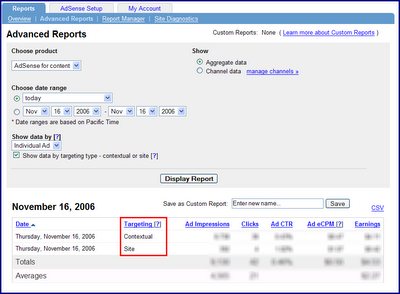
Want to show more CPM ads on your site? It's not possible to request CPM ads, but you can help advertisers get interested in your site by customizing your Onsite Advertiser Sign-up landing page. Advertisers can then create campaigns targeted specifically at your site, directly from your site. And don't forget to focus on quality, placement, and size -- take a look at some important tips from the AdWords team on what advertisers look for in site targeting their CPM ads.
Remember: keep publishing that high-quality content and the advertisers will come to you.
Thursday, November 16, 2006 at 9:41:00 AM
0 comments Permalink Links to this post
Seeing higher earnings in your channel reports?
- Your ads are being tracked on multiple URL channels.
Let's say you've set up 2 URL channels - one to track example.com and to track www.example.com/page. The URL channel example.com will track clicks and impressions from all subdomains, subdirectories, and subpages of example.com. As a result, one click on www.example.com/page will be tracked on both of your URL channels, which means you'll see two clicks recorded in your channel reports. However, your aggregate reports will show you the correct number of clicks, one, with no data duplication. You can learn more about how URL channels will track specific pages in our Help Center. - Your ads are being tracked on both a URL and a custom channel.
Now let's suppose you have a URL channel for example.com and a custom channel called Example Homepage, which you're using on the homepage of example.com. When you receive a click on the ad unit tagged with your Example Homepage custom channel, it will also be tracked on your example.com URL channel. Just like above, this means that you'll see two clicks logged in your channel reports, but only one in your aggregate reports. - Your ads are being tracked on multiple custom channels.
So you've taken advantage of our new feature, and you're tracking each of your red leaderboards with 2 custom channels -- one called Red_ad_units and one called Leaderboards. One click on a red leaderboard will be tracked in both of your custom channels, so you'll see twice as much data when you compare your channel reports to your aggregate reports.
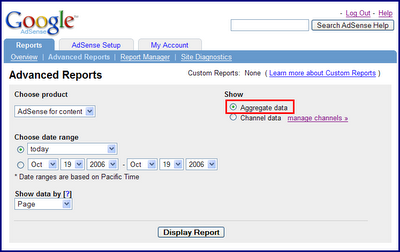
Now get tracking (correctly)!
Thursday, October 19, 2006 at 10:26:00 AM
0 comments Permalink Links to this post
Unlocking the relationship between CTR and earnings
Occasionally, we hear from publishers who are perplexed that their earnings don't change despite an increase in CTR. This phenomenon can seem inexplicable, and when it happens, publishers may suspect that 'smart pricing' has taken effect, or that Google is making revenue share changes. What's really going on?
AdSense is unique because it's designed to maximize eCPM for our publishers, taking into account both the advertiser's cost-per-click (CPC) bid and the likelihood that the ad will be clicked. Some ads are attractive to a broad range of site visitors and will be clicked on more frequently. While this can be great for your CTR, advertisers are often bidding less for these kinds of broadly targeted ads. Other ads are attractive only to a small niche of users. Advertisers will typically pay more for these tightly targeted ads, but those ads are also less likely to get clicked.
Depending on ad inventory, you may see some days on which AdSense will show a lot of high CTR/low CPC variety ads. On other days, you may see the reverse. If you see this correlation in your own AdSense reports, keep in mind that we're always working hard to maximize revenue for our publishers. One aspect of that is being able to best take advantage of the earnings characteristics of different kinds of ads.
Monday, September 25, 2006 at 11:29:00 AM
6 comments Permalink Links to this post
Earnings: Your questions answered
No, there's no minimum number of impressions or clicks for generating earnings. You can start earning the very first time a user clicks on a cost-per-click (CPC) ad or views a cost-per-thousand-impressions (CPM) ad. Keep in mind, however, that you'll need to earn $100 before your earnings will be paid out to you.
If a CPM ad appears on my site, do I need to receive 1,000 impressions before I am paid?
No, with CPM ads you're paid for each impression, so if you receive 1 ad impression, you'll receive 1/1,000 of the CPM bid for that ad unit.
I received 57 page impressions. Why don't I have any earnings?
It sounds like the ads currently appearing on your site are probably CPC ads, so you'll be paid for clicks, rather than impressions. Our system will automatically display whichever ad or ads representing the highest revenue potential for you, whether they're CPC or CPM ads.
How much do you pay per click or impression?
We don't pay a fixed price for each click or impression - we pay you a portion of the amount paid by the AdWords advertiser. This amount varies based on the actual CPC or CPM paid by the advertiser. Each ad that appears on your site will most likely generate a different CPC or CPM.
Do I get paid when visitors use my search box?
With AdSense for search, you'll be paid when users click on the ads that appear on their search results pages, not from the search queries themselves. You won't be paid if a visitor uses your search box, but chooses not to click on the ads on the search results pages.
Do I get paid when visitors click on my link unit topics?
When a user clicks on a link unit topic, you'll be paid for clicks on the CPC ads that appear on the resulting page of highly targeted ads. However, you won't be paid for clicks on the initial topics themselves. Link units can siginficantly boost your overall AdSense revenue by providing even more relevant and monetized content to your users.
Thursday, April 13, 2006 at 8:06:00 PM
4 comments Permalink Links to this post
CPM ads: Knowing the facts can pay off
Myth: All text-based ads are paid on cost-per-click (CPC) basis, and all image-based ads are paid on a cost-per-thousand impressions (CPM) basis.
Fact: Both text and image ads can be paid on either a CPC or CPM basis. AdWords advertisers can choose which type of ad they'd like to create -- e.g., CPM vs. CPC or text vs. image. In order for a CPM ad or an image CPC ad to win in the ad unit auction and appear on your site, it has to produce an effective CPM greater than the sum of the individual text ads that would otherwise appear.
Myth: If I set my ad unit to 'image only', I'll get exclusively CPM ads.
Fact: As mentioned above, image ads can be either CPC or CPM ads, so you could also see CPC image ads. You might also see public service ads if there is a limited inventory of image ads relevant to your site content. As a rule of thumb, we recommend opting into both text and image ads. Doing so expands the pool of advertisers competing to display on your site – both on a CPC and CPM basis – therefore maximizing your site's revenue potential. It also helps to choose an ad format that supports both text and image ads.
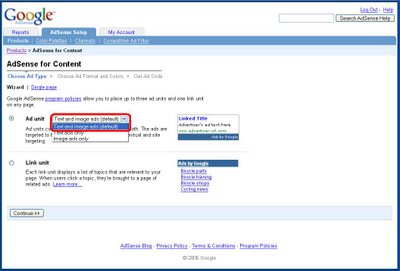
Keep in mind that currently, all CPM ads are site targeted, meaning that your site will only display CPM ads if an AdWords advertiser has decided your content is relevant to their ad campaign. To increase advertiser bidding on your site, you may wish to customize your Onsite Advertiser Sign-up landing page.
Myth: I can't participate in Onsite Advertiser Sign-up because I only want to display text ads on my site.
Fact: Since site-targeted CPM ads can be either text-based or image-based, you can still take advantage of this program even if you only want to show text ads. Advertisers who want to display on your site can create text-based site-targeted ads.
Friday, March 31, 2006 at 8:47:00 AM
0 comments Permalink Links to this post
Why the lower eCPM?
Now that site targeted and contextually targeted ads can be displayed separately in AdSense Advanced Reports, there seems to be some confusion about site targeted ads with lower eCPM. We'd like to explain why you should always feel assured that you're getting the best paying ads for your pages.Site targeted ads compete in the same auction as contextually targeted ads. They will only appear on your site if they represent a higher eCPM than any combination of contextually targeted ads competing to display in the same ad unit. The AdWords auction process takes into account factors such as bid price and clickthrough rate in calculating Ad Rank, the ranking system determining which ads will appear on your page. Opting into site targeted ads should only improve your overall revenue potential by deepening the pool of advertisements competing to display on your sites.
So why is the eCPM associated with site targeted ads sometimes lower than the eCPM associated with contextual ads in your Advanced Reports? The answer is that site targeted ads are most likely appearing on lower performing pages within your account – in other words, pages requiring a lower eCPM to win the AdWords ad auction. For example, say your ad unit on 'PageA.com' has an eCPM of $5.00, and a combination of contextually targeted ads are displaying. Your ad unit on 'PageB.com' has an eCPM of $1.00, and a site targeted ad is displaying because it represents the highest revenue potential for this page.
If these are the only two pages on which you are displaying AdSense ads, your Advanced Reports will show an eCPM of $5.00 for contextual ads, and an eCPM of $1.00 for site targeted ads. However, all of your ad units are automatically optimized to display the highest paying ads available at that moment.
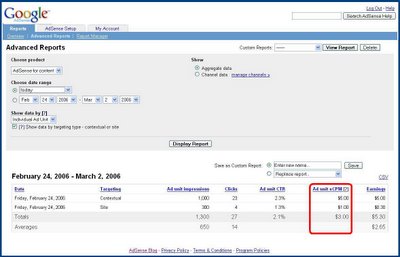
Lastly, please remember that site targeted ads pay on a cost-per-thousand impressions (CPM) basis, not on a cost-per-click (CPC) basis, so you will be paid whether or not your visitors click on them. For site targeted ads, clickthrough rate does not affect eCPM since advertisers bid on a cost-per-thousand impression basis rather than a cost-per-click basis.